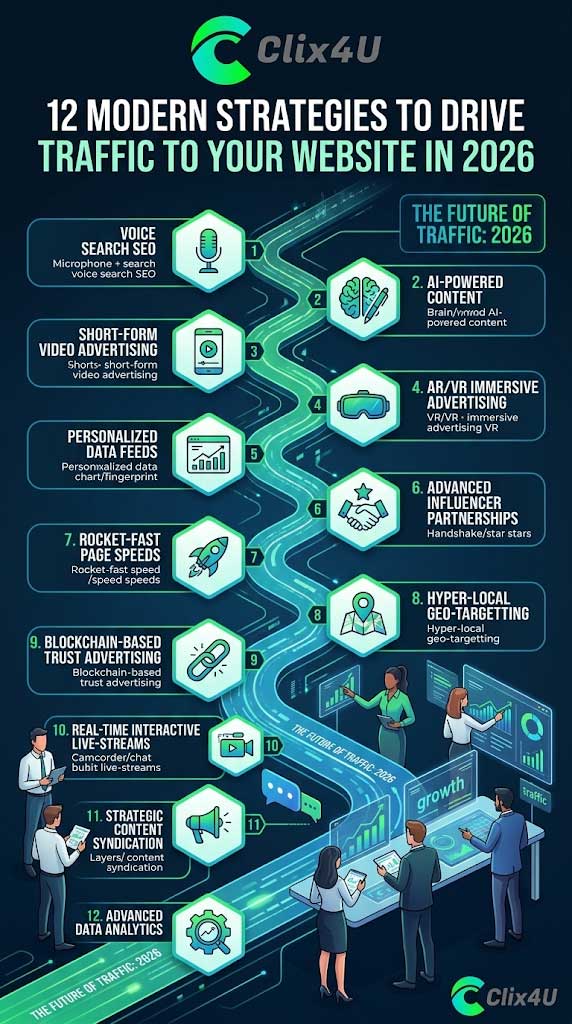
SEO still matters — but today your customers can discover you through Google, AI search, social platforms, video, maps, communities and their inbox.
Driving traffic to a website used to be largely about ranking on Google, publishing blog posts and sharing links on social media. Those fundamentals still matter, but the way people discover businesses has changed. Search results increasingly include AI-generated answers, customers search directly on social and video platforms, local discovery happens through maps and reviews, and useful content can be surfaced across multiple channels before someone ever reaches your website.
The goal, therefore, is not simply to generate more clicks. It is to make your business easy to discover, understand and trust wherever your audience is looking — and then give people a compelling reason to visit your website and take the next step.
1. Create Content That Solves Real Customer Problems
Useful content remains one of the strongest foundations of digital marketing. Instead of creating content simply to “keep the website fresh”, start with the questions, problems and decisions your customers actually face.
Build articles, guides, FAQs, checklists, case studies, videos, podcasts and comparison content around those needs. Demonstrate first-hand expertise, include examples and evidence where appropriate, and make the next step clear with a relevant call to action.
One strong piece of content can also become a video, several social posts, an email, a downloadable guide and material for sales conversations. Think in terms of content systems rather than isolated posts.
2. Optimise for SEO — and for AI/GEO Discovery
Traditional Search Engine Optimisation (SEO) is still essential, but businesses now also need to consider how their information may be discovered and referenced by AI-powered search experiences.
Often described as Generative Engine Optimisation (GEO) or Answer Engine Optimisation (AEO), the objective is not to “game” an AI system. It is to make your expertise clear, useful, credible and easy for search engines and AI systems to understand.
Create pages that answer specific customer questions clearly. Use descriptive headings, logical site architecture, relevant internal links, accurate business information, original expertise and appropriate structured data. Include authorship, evidence, case studies, FAQs where they genuinely help the reader, and clear information about who your business is and what it does.
Importantly, GEO does not replace SEO. Strong technical SEO, crawlable pages, useful original content and a trustworthy brand remain the foundation for visibility in both traditional and AI-assisted search.
3. Build Topical Authority, Not Just Keywords
Ranking for a single keyword is no longer a complete content strategy. Build clusters of useful information around the areas in which you want your business to be recognised.
For example, instead of one page about “commercial cleaning”, a cleaning business might develop service pages, industry-specific pages, pricing guidance, checklists, common problems, case studies and maintenance advice. Together, these resources demonstrate depth of expertise and give searchers multiple pathways into the website.
Start with customer intent: What are people trying to learn, compare, solve or buy? Then create the most useful resource you can for each stage of that journey.
4. Use Social Media as a Discovery Channel
Social media is no longer simply a distribution channel for links back to your website. Platforms such as Instagram, Facebook, LinkedIn and TikTok increasingly function as discovery and research environments in their own right.
Choose platforms based on where your audience spends time and how they prefer to consume information. A professional-services business may benefit from expert commentary and case studies on LinkedIn, while a visually driven consumer brand may gain more from Instagram, TikTok or short-form video.
Avoid posting identical content everywhere. Adapt the message, format and creative to each platform, and use clear pathways back to relevant website pages when a visitor is ready to learn more or enquire.
5. Make Video Part of Your Search Strategy
Video now supports awareness, education, trust and search visibility. YouTube remains an important search and discovery platform, while short-form video on YouTube Shorts, Instagram Reels, TikTok and other feeds can expose a business to audiences who may never begin their journey with a traditional Google search.
Create videos that answer genuine questions: explain a process, demonstrate a product, show before-and-after results, introduce your people, respond to common objections or walk through a customer success story.
Whenever possible, connect the video to a useful page on your website rather than sending everyone to the homepage.
6. Strengthen Your Local Presence
For businesses serving a defined geographic area, local search can be one of the fastest routes to qualified website traffic.
Keep your Google Business Profile complete and accurate, including categories, services, opening hours, photos, videos and website details. Encourage genuine customer reviews and respond to them. Make sure the services and locations described on your website support what appears in your business listings.
Consistent business information across your website and reputable directories also helps customers — and search platforms — understand who you are, what you offer and where you operate.
7. Build an Email Audience You Own
Email remains valuable because it gives you a direct relationship with people who have chosen to hear from you. Unlike social reach, your database is not entirely dependent on a platform algorithm.
Give people a reason to subscribe: useful insights, offers, guides, event invitations, product updates or practical advice. Segment your database where possible so customers receive information relevant to their interests, location or stage in the buying journey.
Use email to bring people back to high-value website content, landing pages, offers and resources — not simply to announce that you have published another blog post.
8. Use Paid Media to Reach High-Intent and New Audiences
Organic traffic is valuable, but paid media can create immediate visibility and provide useful data about what messages and offers resonate.
Google Ads can capture people actively searching for a solution, while Meta, LinkedIn, TikTok, YouTube and other advertising platforms can help create demand, retarget interested audiences and reach specific customer groups.
Modern ad platforms use increasing levels of automation and machine learning, but automation still needs good inputs: strong creative, clear offers, accurate conversion tracking, useful landing pages and a sound understanding of the customer.
9. Participate in Communities and Third-Party Platforms
Your audience may be researching problems in places that are not your website. Depending on the market, that could include Reddit, industry forums, Facebook Groups, LinkedIn communities, review platforms, associations, marketplaces or specialist publications.
The opportunity is not to spam these communities with links. Contribute useful expertise, answer questions and build recognition. Where appropriate, direct people to a deeper resource on your website.
Mentions, reviews, citations and genuine third-party discussion can also strengthen the broader digital footprint that customers encounter when researching your business.
10. Earn Authority Through Partnerships, PR and Expert Contributions
Guest blogging still has value when it is genuinely relevant, but modern authority-building is broader than exchanging articles for backlinks.
Look for opportunities to contribute expert commentary, appear on podcasts, collaborate on webinars, participate in industry research, work with complementary businesses, publish original data or contribute to reputable industry publications.
The aim is to build real-world authority and digital signals around your brand while creating new referral pathways to your website.
11. Improve Internal Linking and the Journey After the Click
Getting someone to your website is only the first step. Once they arrive, help them move naturally to the information they need.
Use internal links to connect related services, articles, case studies and resources. Every important page should have a clear purpose and next action — whether that is reading another guide, viewing a case study, requesting a quote, booking a consultation or making a purchase.
Good internal linking also helps search engines understand the relationship and relative importance of pages across your site.
12. Make Your Website Worth Visiting
Traffic has little value if the website is slow, confusing, unconvincing or difficult to use on a mobile device.
Your website should quickly answer five questions: Who are you? What do you do? Who do you help? Why should someone choose you? What should they do next?
Pay attention to mobile usability, page speed, accessibility, navigation, trust signals, conversion tracking, forms and landing-page relevance. Use analytics and actual customer behaviour to identify where people leave, what generates enquiries and which channels produce valuable customers — not just visits.
A Better Way to Think About Website Traffic
The modern customer journey is rarely linear. Someone may first see a short video, later search your brand on Google, read reviews, encounter an AI-generated answer, visit your LinkedIn profile, receive an email and only then return to your website to enquire.
That is why the strongest traffic strategy is an integrated one. SEO, GEO, content, social media, video, paid advertising, email, local search and brand activity should reinforce one another rather than operate as separate tactics.
The question is no longer simply, “How do we get more people to our website?” It is, “How do we make our business discoverable and compelling wherever our customers are looking — and turn that attention into measurable growth?”
Quick 2026 Checklist
- Does your website clearly answer the questions customers actually ask?
- Can search engines crawl and understand your important pages?
- Is your content structured clearly enough to support traditional and AI-assisted discovery?
- Are you publishing original expertise rather than generic, interchangeable content?
- Are you visible on the social, video and community platforms your customers use?
- Is your Google Business Profile complete and current if local search matters to you?
- Are you building an opted-in email database?
- Do your paid campaigns send people to relevant landing pages?
- Are reviews, case studies and third-party mentions strengthening trust?
- Can you measure which channels generate enquiries, sales and revenue — not just traffic?